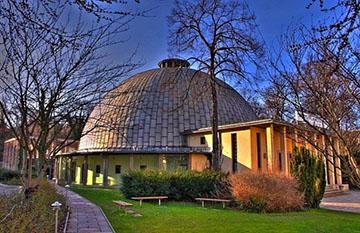
 The first dome that could be called "geodesic" in every respect was designed after World War I by Walther Bauersfeld, chief engineer of the Carl Zeiss optical company, for a planetarium to house his planetarium projector. The dome was patented, constructed by the firm of Dykerhoff and Wydmann on the roof of the Zeiss plant in Jena, Germany, and opened to the public in July 1926. Some 20 years later, R. Buckminster Fuller named the dome "geodesic" from field experiments with artist Kenneth Snelson at Black Mountain College in 1948 and 1949. Snelson and Fuller worked developing what they termed "tensegrity," an engineering principle of continuous tension and discontinuous compression that allowed domes to deploy a lightweight lattice of interlocking icosahedrons that could be skinned with a protective cover. Although Fuller was not the original inventor, he developed the intrinsic mathematics of the dome, thereby allowing popularization of the idea — for which he received U.S. patent 2,682,235 29 June 1954. The first dome that could be called "geodesic" in every respect was designed after World War I by Walther Bauersfeld, chief engineer of the Carl Zeiss optical company, for a planetarium to house his planetarium projector. The dome was patented, constructed by the firm of Dykerhoff and Wydmann on the roof of the Zeiss plant in Jena, Germany, and opened to the public in July 1926. Some 20 years later, R. Buckminster Fuller named the dome "geodesic" from field experiments with artist Kenneth Snelson at Black Mountain College in 1948 and 1949. Snelson and Fuller worked developing what they termed "tensegrity," an engineering principle of continuous tension and discontinuous compression that allowed domes to deploy a lightweight lattice of interlocking icosahedrons that could be skinned with a protective cover. Although Fuller was not the original inventor, he developed the intrinsic mathematics of the dome, thereby allowing popularization of the idea — for which he received U.S. patent 2,682,235 29 June 1954.
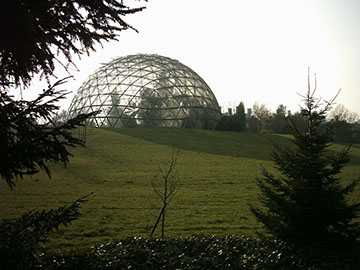 The geodesic dome appealed to Fuller because it was extremely strong for its weight, its "omnitriangulated" surface provided an inherently stable structure, and because a sphere encloses the greatest volume for the least surface area. The geodesic dome appealed to Fuller because it was extremely strong for its weight, its "omnitriangulated" surface provided an inherently stable structure, and because a sphere encloses the greatest volume for the least surface area.
- Wikipedia
|
